Your logo is the most repeated element of your brand. It appears on every touchpoint — website, packaging, social media, business cards, signage — thousands of times. Getting it right is one of the most important design decisions your business will make.
The 5 Principles of Effective Logo Design
1. Simplicity
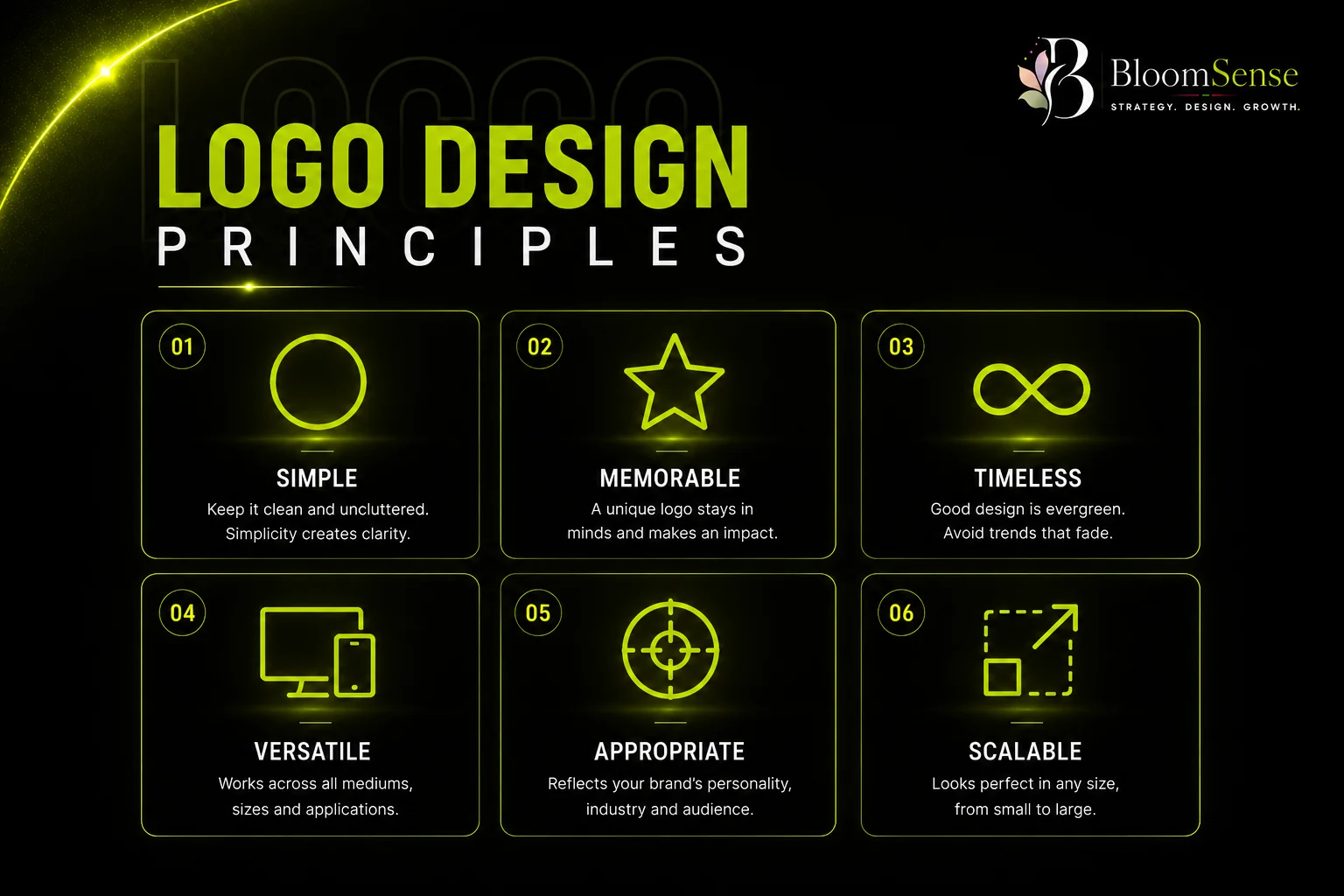
The most memorable logos in the world are also the simplest. A simple logo is easier to recognise, easier to remember, and easier to reproduce accurately across any medium. Complexity adds cost and reduces consistency.
2. Memorability
Can someone recall your logo after seeing it once? Memorable logos have a distinctive shape, colour relationship, or visual idea that sticks. Generic shapes and generic type are not memorable.
3. Versatility
A professional logo must work at any size — from a 16px favicon to a 10-metre billboard. It must work in colour and in black and white. It must work on light and dark backgrounds. Test yours in all these contexts before signing off.
4. Timelessness
Design trends cycle every few years. Your logo needs to last 10–20. Avoid design choices that are heavily trend-dependent — gradients, drop shadows, overly complex illustrations, and typefaces that feel distinctly of their era.
5. Relevance
A great logo is appropriate to its brand and industry context. A law firm and a children's toy company have very different visual languages. Your logo should feel right for your category — while still being distinct within it.
A logo doesn't need to show what a company does — it needs to represent it. Nike's swoosh doesn't look like a shoe. Apple's apple doesn't look like a computer.
What to Ask When Evaluating a Logo Design
- ▪Does it work in black and white?
- ▪Can I recognise it at 16px?
- ▪Is it distinct from our main competitors?
- ▪Will it look dated in 10 years?
- ▪Does it represent our brand's personality?
- ▪Is the system (primary, secondary, icon) complete?
The Most Common Logo Design Mistakes
- ▪Using clip art or template-based designs
- ▪Too many colours (2–3 maximum)
- ▪Type that's too small or too decorative to be legible
- ▪No logomark — only a wordmark (limits versatility)
- ▪Designing for print without considering digital contexts
Strategic branding, design, and growth company based in Noida, India. We build category-defining brands through purpose, perception, and intelligent creativity.